


Most Amazon advice starts with ads. Saniya Aggarwal starts with the spreadsheet.
Before co-founding Prima Mode, Saniya cut her teeth at Forum Brands, Thrasio, and other Amazon aggregators, where she owned the P&L and everything that came with it: inventory forecasting, pricing, SEO, advertising, and profitability.
Today, Prima Mode has helped brands grow from $0 to $1M on Amazon while advising established brands on unit economics and channel strategy.
Her superpower isn’t ad hacks. It’s breaking Amazon down to its underlying mechanics, and the operating decisions that separate profitable brands from expensive ones.
Text answers below have been edited for length and clarity. Full answers are in video. (We highly recommend watching!)
Set yourself up for Amazon success
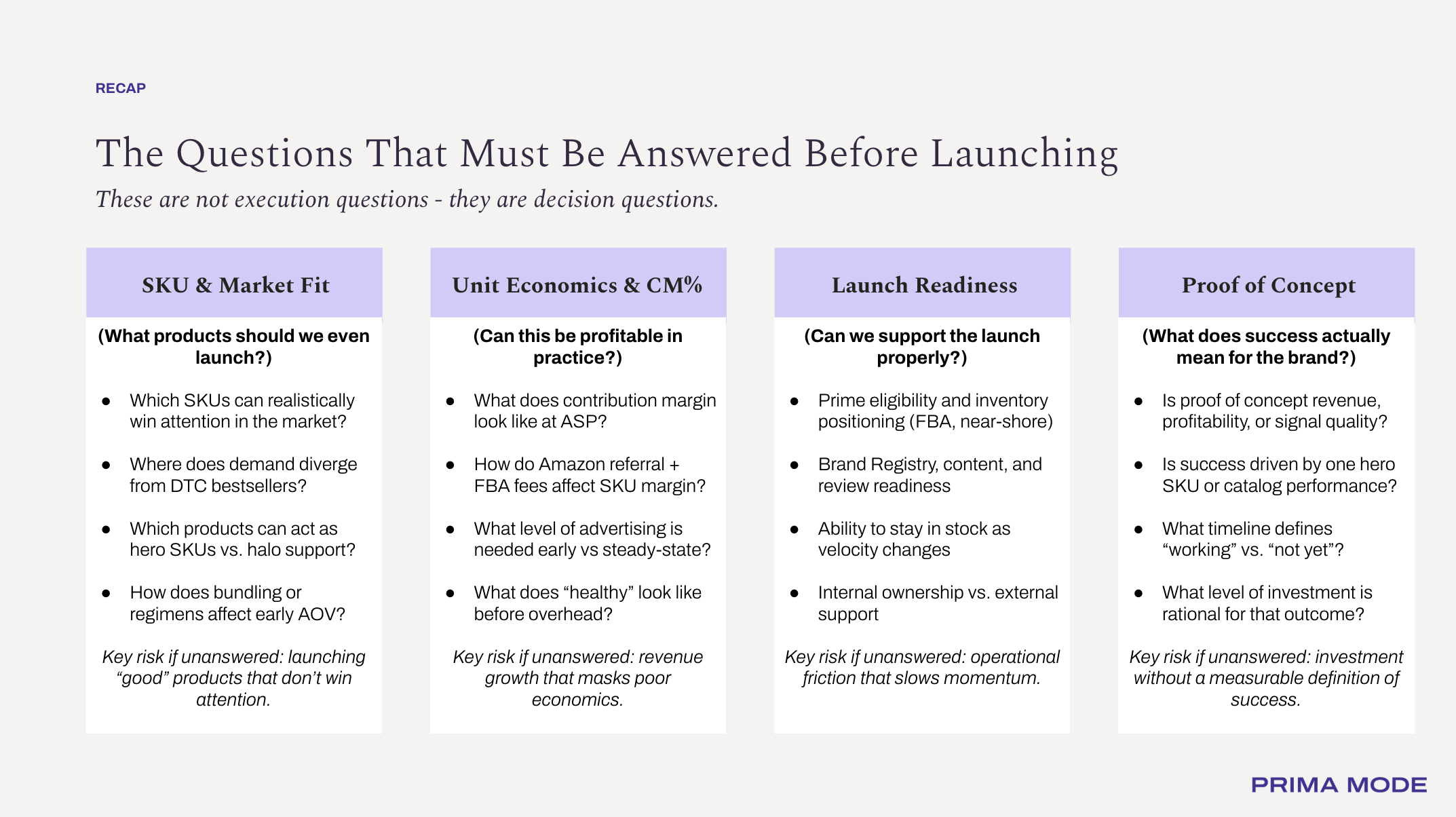
It’s best for brands to prove demand off Amazon first. Test the product, understand your customer, and make sure the economics work before putting serious resources behind the platform. Amazon is powerful, but it’s also expensive.
The biggest mistake brands make is treating Amazon like an ad platform. Ads are only one piece of the equation. Your listing quality, conversion rate, reviews, content, and inventory all determine whether those ads work.
Your first 60–90 days are what Amazon calls the “honeymoon period.” A window where what you do has an outsized impact because the platform is trying to help new brands gain traction. The brands that make the most of that window invest in the full Amazon experience: strong listings, compelling content, reviews, competitive positioning, and inventory planning.
The 3 phases to launch on Amazon
Launching on Amazon is less about “turning on sales” and more about building the infrastructure behind them. A typical Amazon launch takes 2–4 months when the foundation is already in place. Here are the three phases:
1. Technical setup: The first phase is the least exciting. Brands need to get the infrastructure right: Seller Central, Brand Registry, trademarks, compliance, UPCs, and catalog setup. These details can feel administrative, but fixing them after launch is much harder.
2. Content and listings: Next comes creating your catalog of products. A common misconception is thinking you need to upload all your SKUs at launch. Many brands are better off starting with a focused group of products they can actually support with inventory, content, and marketing resources. Think of your Amazon listing as your salesperson. Hero images, video, A+ content, reviews, and competitive positioning all influence whether a shopper converts.
3. Operations: The final piece is operations, including inventory planning and setting yourself up to be Prime eligible (either Fulfilled by Amazon or Fulfilled by Merchant).
The Amazon P&L Waterfall
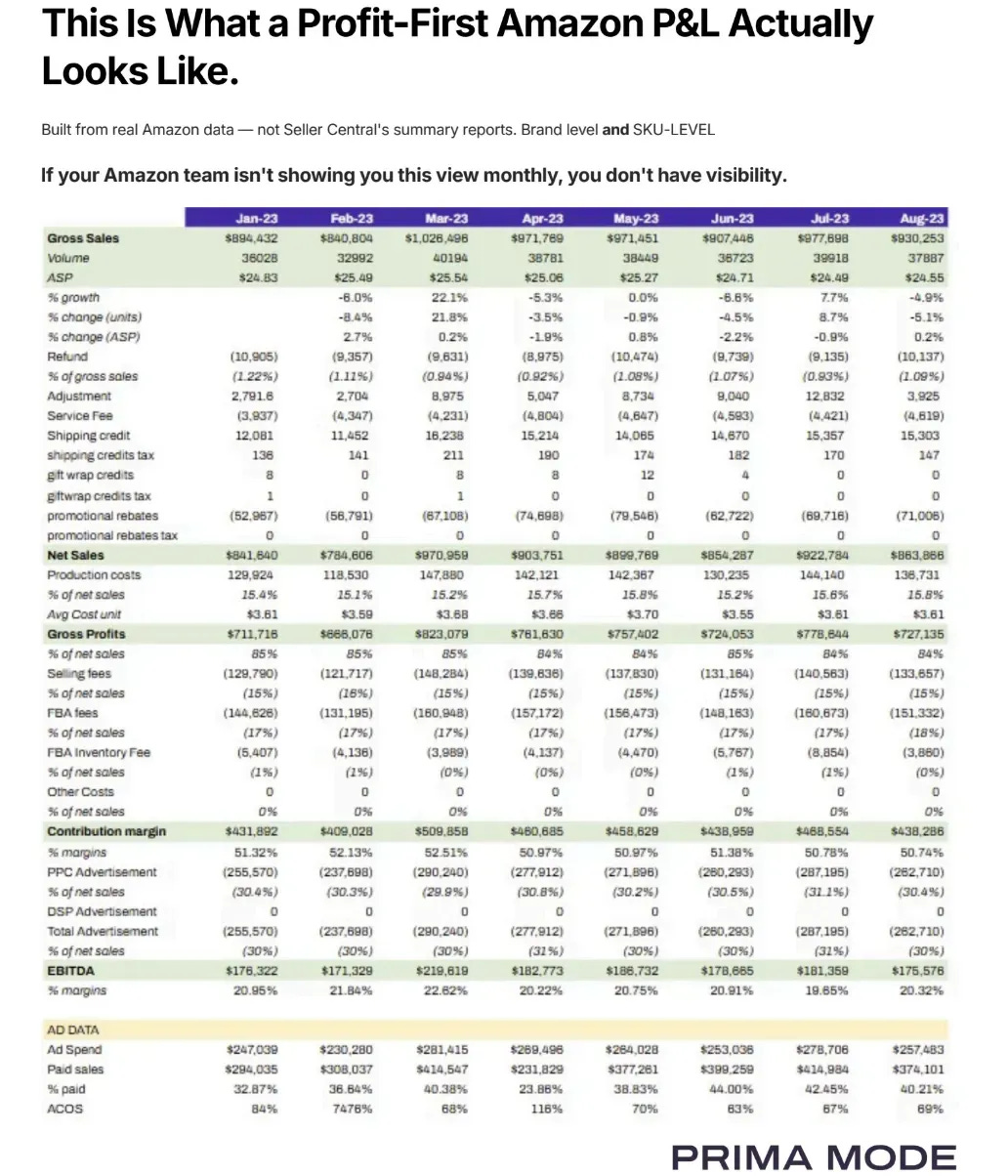
Think of this Amazon P&L waterfall as your unit economics. Most brands only track re
venue and top line, but on Amazon, there are multiple layers of costs between your selling price and your actual profit.
Selling price → refunds → COGS → Amazon fees → FBA costs → inventory costs → contribution margin → advertising → profit
There are the obvious costs, like production and landed COGS. Then there are the Amazon-specific costs that are easier to overlook: referral fees, fulfillment fees, storage fees, and aged inventory costs.
At the start, you have your selling price. Then you go into refunds/returns. Food and beverage brands on average have 1–5% in returns. Add your COGS (production cost plus landed fees) to get your gross margin. That’s your net selling price.
Then there are the Amazon-specific costs:
Selling fees: 8–15% of your selling price (If your product is below $15, you’re charged 8%. If it’s more than $15, you’re charged 15%.)
FBA fees: 15–35% of your selling price (based on the dimensions of your product plus the weight(
Inventory fees: Increases if your product’s in storage for more than six months,
All of these fees are your contribution margin. Don’t decide on an ad budget and work backward. Understand your contribution margin first. A product can look successful from a revenue perspective while losing margin once the full Amazon P&L is calculated.
The top ways brands lose money on Amazon
What can brands do to save margin, or things that typically go wrong? I divide it into three pieces:
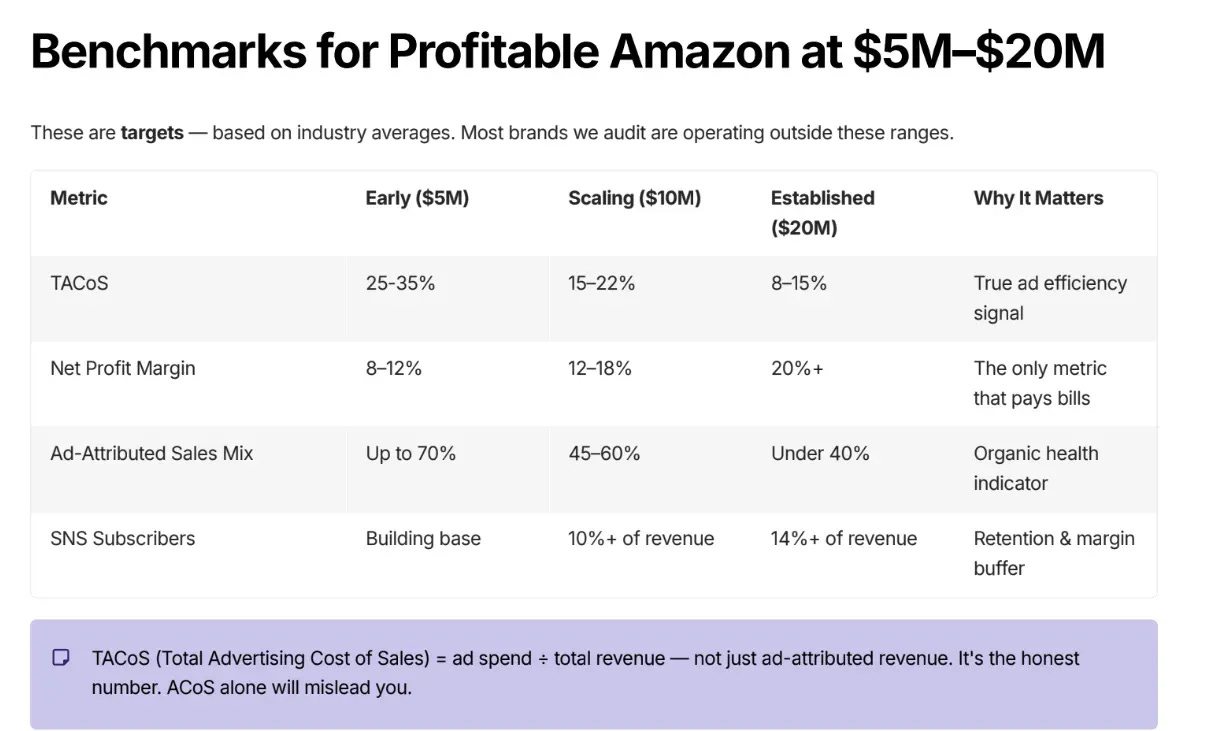
1. Ads without P&L visibility. Many brands look at ROAS because it’s the easiest metric to see, but ROAS only shows ad performance, not the health of the entire channel. Instead, look at TACOS (Total Advertising Cost of Sales) because it shows how advertising affects the entire Amazon business, including organic growth. Also under your contribution margin by SKU so you know what you can spend on ads.
2. Inventory chaos. Going out of stock is one of the fastest ways to lose momentum on Amazon. It can hurt rankings, create additional fees, and fulfillment issues. Especially for emerging brands, where demand can change quickly, having a strong forecasting process and enough inventory coverage is critical.
3. Amazon as a side channel. Even brands with strong potential slow their own growth because Amazon wasn’t fully integrated into the business. inventory wasn’t allocated, ad budgets weren’t planned, or the team wasn’t aligned with what was happening off Amazon.
Advice from a verified Amazon Store Partner
Amazon has a lot of built-in tools and opportunities for CPG brands to use:
1. Creators: Amazon’s Creator Connections program gives emerging brands a way to access creators through Amazon’s ecosystem, without having to build every relationship from scratch through affiliate or PR channels.
2. Content: Amazon is becoming increasingly visual, which means you need video and Premium A+ Content across all products and a strong optimized Brand Store.
3. Campaign strategy: Category Conquesting Campaigns help brands show up against competitors and capture new shoppers. Branded Defense Campaigns protect your own brand search so competitors don’t steal customers already looking for you. Don’t over-invest in branded defense too early, especially if there usually isn’t enough competition. Branded defense becomes more valuable later, around $10M–$15M+ in Amazon sales.
4. Retention: For CPG brands, Subscribe & Save and repeat purchase behavior matter. Amazon isn’t just a place to acquire customers. It can become another channel for understanding retention and customer value.
Working with Prima Mode
Prima Mode typically partners with brands in four different ways, depending on where they are in their Amazon journey.
1. Amazon Launch Blueprint (Typically 2–4 months, $8K–$10K one-time): This is for brands getting ready to launch on Amazon. We work with you until your products are actually sellable, whether that takes two months, six months, or somewhere in between. That includes everything from the technical setup and Brand Registry to listings, content, and launch strategy.
2. Brand P&L Diagnosis: This is for brands that want a much clearer picture of their Amazon economics. We break down the channel P&L, identify where margin is being lost, and help teams understand what profitability really looks like at the SKU level.
3. End-to-end management (Typically $4K–$5K/month): This is our most common partnership. We manage the entire Amazon operating system using our P&L framework, from listings, SEO, and advertising to inventory and ongoing optimization. For some launch-stage brands, we’ve also explored a lower monthly retainer plus a performance-based model so we can grow alongside the business.
4. Brand advisor / foundational sprint (6–8 weeks, $3K one-time): For teams that already have Amazon in-house but want a second set of eyes, we embed with the team, identify the biggest opportunities, and help improve everything from unit economics and listings to advertising, packaging, and overall account health.
But outside of that, I love meeting new founders, learning about new brands, and talking through Amazon strategy. So I’m always happy to jump on a call.


