

TRIP didn’t sell CBD. It sold calm. Now it’s worth $300M.
The 12 moves that made TRIP hard to ignore.

👤 Contributed by Usman Gulma
You’re standing in the beverage aisle and notice something strange. It’s not really selling drinks anymore. It’s selling solutions.
Better energy. Better protein. Better gut health. Better hydration. Better focus. Better sleep.
And now: calm.
A decade ago, a drink designed to help you relax would have felt pretty niche. Drinks were for waking you up, getting you through a workout, or having something cold at the end of the day.
Then drinking less alcohol became mainstream. Functional beverages moved into grocery stores. Wellness became less of a niche interest and more of an expectation.
TRIP saw an opening.
Founded in 2019 by Olivia Ferdi and Daniel Khoury, the company started with a simple observation: people wanted healthier ways to unwind. Daniel discovered CBD while recovering from an injury before their wedding.
CBD was the starting point. The bigger idea was giving people something to drink when they wanted to take the edge off.
Today, TRIP is one of Europe’s biggest challenger beverage brands, with $100M+ in profitable revenue, a $300M+ valuation following a $40M raise, and a growing U.S. presence that includes Whole Foods and thousands of other doors.
So how did a CBD drink get here?
Not through one big breakthrough. Through a series of very good decisions.
1. They found the occasion first.
The easy TRIP story is that the founders spotted CBD early.
They did. So did a lot of other people. The better question is how were people going to use it?
TRIP didn’t ask consumers to start “drinking CBD.” It stepped into something they were already doing: having a drink after work to unwind. That puts you in a much bigger competitive set. The competitor isn’t another CBD drink. It’s the glass of wine. The beer at dinner. Whatever someone reaches for when they’re done with work and want to switch off.
In CPG, the product next to you on shelf isn’t always the thing you’re competing with. Sometimes it’s a habit. And replacing a habit is much easier than inventing one.
2. They sold the feeling, not the ingredient.
CBD required some explanation. Calm didn’t.
You don’t need to understand cannabinoids to understand wanting to feel less stressed after a long day. This is where functional brands can get too interested in their own formulation. Founders know the ingredient, dosage, sourcing and mechanism. Consumers want to know what happens after they drink it.
Red Bull doesn’t need you thinking about caffeine. TRIP doesn’t need you thinking about CBD. The ingredient is what makes the product possible. The feeling is what makes people want it.
3. They made CBD look like a drink.
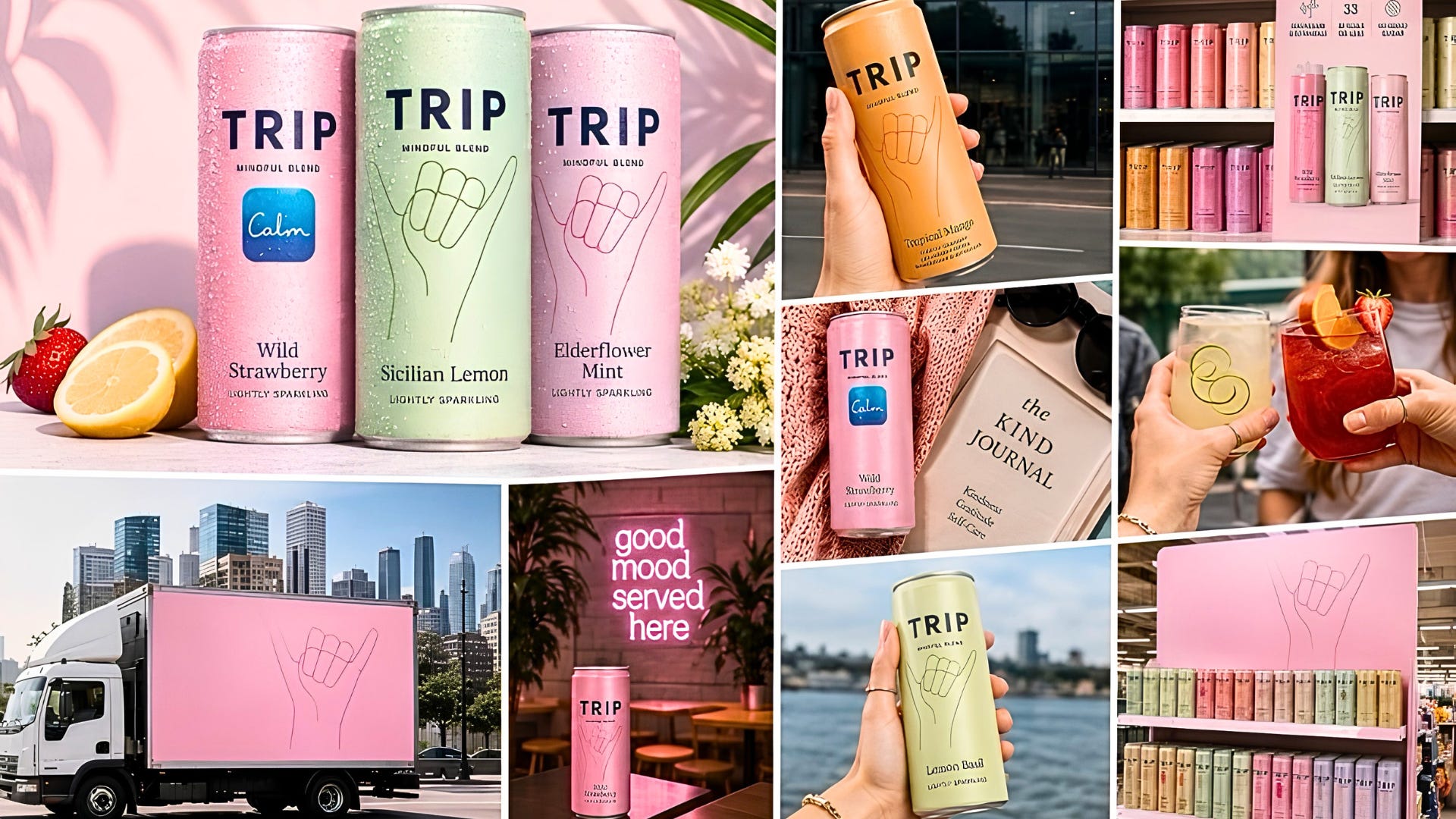
A lot of early CBD products looked like supplements because they were being sold to people who already knew what CBD was. TRIP looked like a beverage brand. Pastel cans. Clean typography. Premium, but not clinical.
You didn’t have to think of yourself as a “CBD person.” You could just think the can looked good. Instead of spending years convincing people to rethink CBD, TRIP made the product easy to understand..
4. The made a can that got people’s attention.
TRIP’s packaging was built to travel. On a desk. In a gym bag. In a café. In someone’s Instagram post. Every time the product shows up somewhere, the brand gets another impression without buying another ad.
One sighting doesn’t mean much. But five or ten over a few months starts to feel familiar. That’s a much more useful way to think about packaging than “does this look good on shelf?”
5. They made wellness something you wanted, not something you needed to fix.
A lot of functional products start with a problem. You’re tired. Dehydrated. Stressed. Not sleeping.
TRIP didn’t need the consumer to feel broken. It offered a better version of a normal moment: winding down after work, having something at dinner, taking a break. That gave the brand room to appeal beyond hardcore wellness consumers. You didn’t need a health goal to justify buying it.
That is a meaningful difference. “Fix yourself” is a narrower proposition than “this is something I enjoy having in my life.” And the second one tends to make a much nicer brand.
6. Social created discovery. Retail created habit.
TRIP generated huge social reach and became the best-selling beverage brand on TikTok Shop. Social clearly mattered. But TikTok is not a beverage distribution strategy. Social gets you curious. Retail gives you somewhere to buy the thing.
TRIP benefited from having both. You see it online. Then you find it at Whole Foods. Then you see it at a café. Then you see your friend drinking one. Eventually it stops feeling like a brand the algorithm is pushing at you and starts feeling like a brand that exists.
7. They chose the right doors over chasing more doors.
Early on, TRIP built presence across cafés, lifestyle retailers, and hospitality. Those accounts do more than sell cans. They give the brand context. A product sitting in a trusted venue gets some borrowed credibility. The consumer may not know TRIP yet, but they know the environment around it. That’s particularly useful when the product itself is unfamiliar.
So the useful retail question isn’t just “How many doors can we get?” It’s “What is this door going to do for us?” The right 50 doors can do more for you than the wrong 500.
8. They gave every channel a job.
TRIP didn’t need every channel to do the same thing. TikTok for discovery. Retail for trial and repeat. DTC for a direct customer relationship. Amazon for convenience. Hospitality for an existing social occasion.
That’s a much more useful definition of omnichannel than simply being everywhere. You need the channels to work together. If every channel is doing the exact same job, you probably have too many channels.
9. Eventually, distribution became marketing.
By 2025, TRIP had reached roughly 50,000 retail doors globally, including more than 10,000 in the U.S. At that point, the shelf is doing a lot more than closing the sale. It introduces new people to the brand. It reminds existing customers about it. And gives the product a very simple form of social proof: other people are buying this.
For beverage companies especially, distribution and marketing eventually start doing some of the same work. Every new door becomes another physical media placement.
10. They built a brand with room to grow.
This is where TRIP’s positioning really paid off. It had built an association with calm, unwinding and wellness rather than locking itself into CBD. That gave it room to move into gummies, magnesium, adaptogens, electrolytes and other formats.
That is one of the biggest benefits of building a real brand. You earn permission to launch the next thing.
11. They expanded the occasion, not just the SKU count.
There’s a difference between adding another product and giving someone another reason to buy from you. A new flavor is another version of the same drink. A new format can fit into another part of someone’s day.
If you own “unwinding,” there are plenty of ways to show up around that need. The question becomes less: What should we launch? And more: Where else does this consumer need us?
12. They waited before going after the U.S. market..
TRIP spent years building in the U.K. before making the U.S. a major growth priority. By then, it had learned a lot about the positioning, customer, products, retail strategy and channels.
That doesn’t make entering a new market easy. It just means they’re not trying to learn everything at once. The test isn’t really whether consumers like TRIP. Americans already understand functional beverages.
It’s whether “I want to unwind” can become as routine as “I need coffee” or “I need electrolytes”? Because liking a product is one thing. Buying it every week is a business.
The real advantage was the sequence.
CBD helped get TRIP started. TikTok helped people discover it. The cans made it recognizable. Retail made it familiar. Distribution made it harder to miss. And the brand gave the company room to keep expanding.
None of those things, by itself, gets you to $300M. The interesting part is that each decision made the next one easier. TRIP didn’t win because it was the first company to sell CBD drinks. It won because it figured out what the CBD drink was actually for, and then built the entire business around that answer.